Back
Scroll to top

When to Refinance Your Home

3 min read
House sitting on pile of money, hand on mouse computer and keyboard

Ready to talk to an expert?

When is it a good idea to refinance? It depends on your financial situation and what you’re looking to get out of refinancing.

Here are some common scenarios where refinancing your mortgage makes sense.

Lower Your Interest Rate

One of the most common reasons to refinance a home is to lower the interest rate.

If you are able to find rates that are 1.5%-2% lower than you are paying now, it may be worth thinking about. Keep in mind however, that when you refinance you will need to pay closing costs and possibly extend your loan terms.

Refinancing could actually lead to higher monthly payments than you have under your current terms, so do the math beforehand.

Make Your Monthly Payment More Affordable

If you are having trouble making your monthly payment and aren’t as concerned about paying more over the life of the loan, refinancing may be a good option.

You can lower your monthly mortgage payment by extending the loan terms. While it’s not advisable from an investment perspective, sometimes affordability is the most important factor.

Build Equity Quickly and Pay Off Your Mortgage Sooner

For people who have no problem paying their monthly mortgage payment, refinancing to shorten the loan term is a great way to quickly build equity.

It will also enable you to pay off your mortgage sooner, with less interest. Of course, since you’re paying off the same amount in a shorter period of time, your monthly payment will be higher.

Change Your Loan Type

Adjustable-rate mortgages (ARMs) typically have interest rates that start off low and increase over time.

Depending on your situation, you may be interested in changing your loan from an adjustable-rate mortgage to a fixed-rate mortgage before the interest rate increases. Refinancing will enable you to make this change.

While this may seem like a great idea, make sure you compare the closing costs with how much you will save over the life of the loan. If you’re going to be in the house for at least a few more years, changing your loan type will usually work out in your favor.

Consolidate Your Debt

Have you taken out a home equity line of credit (HELOC) on your home? If so, refinancing is a great way to consolidate your debt.

Combining your HELOC with your mortgage will make things simpler by giving you only one payment and one interest rate.

If you find yourself in any of these situations, refinancing may be the way to go.

To learn more about the ins and outs of refinancing, contact one of our mortgage specialists at a branch near you.

Ready to talk to an expert?

Share:

You may be interested in...

How Much Money Should I Have Saved by the Time I am 30? Are you approaching 30? How much money do you have saved? According to CNN Money, someone between the ages of 25 and 30, who makes around $40,000 a year, should have at least $4,000 saved. However, because everyone’s financial situations are unique and are influenced by their spending habits, income, debt and overall lifestyle, not every 30-year-old will have the same amount of money tucked away — and that’s okay! Rather than tell you a precise amount that you should have saved by the time you are 30, we will provide you with savings tips to help you reach your specific financial goals, whatever they may be. 3 Financial Goals for People Under 30 By now, you know that the most effective way to save money is to set a monthly budget for yourself and stick to it. Some tips for setting a realistic and effective budget include: Recording your daily spending Tracking your spending habits for at least a month Still budgeting for fun and entertainment Making automatic savings contributions Clearly defining spending priorities But what else can you do to ensure you have a healthy chunk of change stashed away by the time you hit the big 3-0? 1. Have no consumer debt. By the time you are 30 years old, you should have auto loans, credit cards and other consumer debt paid off. Remember, it’s better to have $500 in the bank with no debt than to have $5,000 in the bank with significant debt. 2. Make at least one (smart) investment. According to Investopedia, “A mutual fund is an investment vehicle that is made up of a pool of funds collected from many investors for the purpose of investing in securities such as stocks, bonds, money market instruments and similar assets.” Mutual funds are the largest and most popular investment vehicle for the retail buyer, making them a great investment option for young people with limited investing experience. 3. Have at least three months of living expenses saved. Everyone should have an emergency fund to better prepare for unexpected events, such as an expensive auto breakdown or unemployment. When saving money for your emergency fund, make sure you are putting money in a savings account (separate from your checking account). First Bank* Helps You Save No matter your age, 3 min read
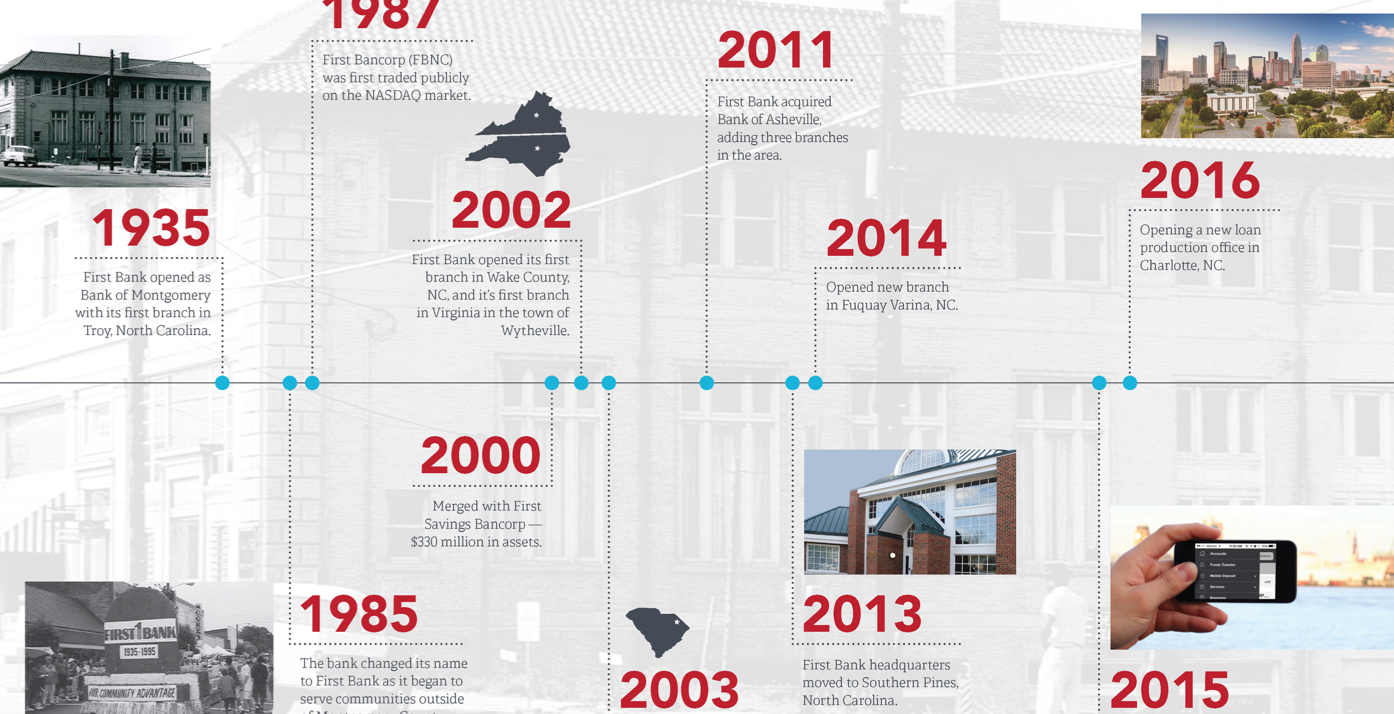
NC Bank If you are looking for one of the best North Carolina banks, consider a visit to your local First Bank. First Bank is an NC bank that is small enough to know you by name, but large enough to meet all of your banking needs. We have more than 100 convenient locations throughout the state of North Carolina. Plus, First Bank was recently recognized as one of the by Forbes. Banking Services First Bank offers a variety of banking services for families, individuals, and business owners in North Carolina. Some of our services include: Personal banking: Checking accounts, savings accounts, debit cards, personal loans, and more. Business banking: Checking accounts, savings accounts, loans and credit, merchant services, and more. Mortgages: Conventional loans, jumbo loans, government loans, VA loans, and one-time close construction-to-permanent loans. We also have a Financial Education Center where you can find articles about buying a home, starting a business, our activities in the community, and more! Click here to explore more banking options. First Bank’s Mission At the beginning of the Great Depression, a small town in North Carolina lost its only bank. That town was Troy, NC, and in 1935 First Bank opened its first branch to help with the loss. At that time, we were called Bank of Montgomery, and we were known for helping farmers and local businesses manage their money for 3 whole decades. In 1985, we changed our name to First Bank, and a lot has changed since then. The manufacturing, industrial, and technology industries have grown, and we’ve continued to evolve to meet the needs of our customers. Our mission is to show that we care about our customers, and to provide them with safe and convenient banking. If you are looking for a North Carolina bank that strives to meet your needs, visit a First Bank branch near you. Loans subject to credit approval. Member FDIC. Sources: NCpedia: http://www.ncpedia.org/history/20th-Century/great-depression 2 min read
First Bank logo
Privacy Overview

This website uses cookies so that we can provide you with the best user experience possible. Cookie information is stored in your browser and performs functions such as recognizing you when you return to our website and helping our team to understand which sections of the website are the most popular and useful.