Back
Scroll to top

Fraud Alert: Impersonation Scams

Running A Business 2 min read

In this post, we’ll explain how impersonator scams work, how to recognize the red flags, and most importantly, how to protect yourself and your accounts.

What’s an impersonator scam?

Fraudsters can mask their phone numbers and email addresses to look like they are contacting you on behalf of someone at First Bank. They will ask you to validate your account by providing your online banking username, password, or secure access code. With this information, they could attempt to hack into your account.

How to avoid this scam:

To keep your accounts safe, remember that First Bank will never ask you for a security code, multifactor authentication code, username, or password. Your login credentials should never be shared with anyone.

If someone contacts you from First Bank and asks for any of this information, hang up and stop all communication immediately. Manually dial our customer support team at 1-866-792-4357 and report the incident.

What does an impersonator scam look like?

Impersonator scams start with a phone call, text message, or email that appears to come from a trusted source—like First Bank, a government agency, or a well-known company. The scammer will spoof the caller ID or email address to make it look legitimate. Here’s an example of what a fraudulent text message could look like. Notice that the text message on the left asks for User ID and the other is prompting you to click a fraudulent website link.
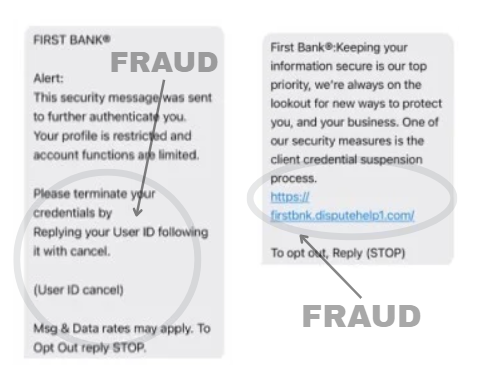
The scammer will create a sense of urgency or a situation where you need to take some sort of action – like replying to a text message or clicking a link. From there, they will ask for sensitive details like your online banking username, password or a secure access code. These scams can be highly convincing, often using official sounding language.

Stay Vigilant, Stay Secure

Impersonator scams are designed to catch you off-guard, but with awareness you can stay one step ahead. Always remember: First Bank will never ask for your login credentials, secure access codes, or personal information through unsolicited calls, texts, or emails. If something feels off, trust your instincts—hang up, don’t click, and contact us directly.

For additional security tips on how to protect your accounts, spot the warning signs, and protect yourself against scammers, visit our Fraud Resources page.


Share:

You may be interested in...

Small Business Loan Rates in North Carolina For competitive small business loan rates* in North Carolina, stop by your local First Bank branch to compare loans with flexible terms and highly competitive rates. We make borrowing money for your business easy and provide the necessary financing for you to be successful in your venture. Small Business Loans at First Bank First Bank is dedicated to helping you navigate the small business loan process. A government-sponsored loan from the Small Business Administration (SBA) can help you grow your business when traditional bank financing may not be an option. We have an SBA team with expertise in different types of SBA lending programs. Some of our solutions for your small business include: Long repayment terms up to 25 years Lower monthly payments Competitive fixed or variable rate options 504 refinancing for large debts For more information on applying for a small business loan, contact a First Bank SBA team member. Additional Loan Options for Businesses In addition to small business loans, First Bank offers a variety of other loan options to help your business succeed. We offer: Business Credit Cards with Rewards—These credit cards offer low rates, no annual fees, and a rewards program with everyday purchases. Lines of Credit—This solution allows you to access cash for any business venture quickly and efficiently. You can repay and reuse your credit line as needed. Business Loans—Our business loans can help you expand your business, fund new equipment, and increase your revenue. Commercial Mortgages—Our specialists provide competitive pricing on a variety of commercial mortgage products and can help structure a loan specific to your needs. Visit First Bank Today To compare small business loan rates, visit your local North Carolina First Bank. With more than 100 locations in North Carolina, we are determined to help you choose the best option for your financial needs. ——— Sources: SBA: https://www.sba.gov/content/504-debt-refinancing-program *Loans subject to credit approval. 2 min read
Commercial Loan Payment Calculator Are you interested in obtaining a commercial mortgage? A commercial loan calculator* can help determine your monthly payments. This is important because purchasing a location for your business is significant and requires a lot of preparation. Calculating your monthly mortgage payments before applying is one way you can ready yourself to take out a commercial loan. Calculate Your Monthly Commercial Mortgage Payments Repayment structures are different for commercial mortgages than residential mortgages. Commercial mortgages typically have two components: the amortization and the balloon payment. The amortization or the term of the loan calculates your monthly payment. The balloon payment becomes due after a specified period of time, requiring the borrower to pay that amount in full, refinance, or sell the property. The commercial mortgage loan experts at First Bank are a great resource and can help you determine a monthly commercial mortgage payment (come by your local branch to speak with one today). You can also use our commercial loan calculator. This tool computes monthly principal and interest payments, and balloon repayments. All you have to do is enter information about your loan and click Calculate Your Results. What you will need to know: Loan amount – The total loan amount desired. Interest rate – The percentage you pay for the use of an amount of money for a specified period of time. Individual loan interest rates depend on a number of factors such as current typical rates, location, and financial records. Interest rates will be either fixed or adjustable. Fixed rates will not change over the term of the loan, allowing for predictable payments. Adjustable interest rates can adjust either up or down at defined intervals according to a market index, which may increase or decrease your payments accordingly. Term in number of years – The time limit within which the mortgage loan must be repaid. Commercial mortgage loans are offered in a variety of term lengths. Generally the longer the term, the smaller your minimum monthly payments will be. Amortization term in number of years – The number of payments over which your loan payment is calculated. If this is longer than the term, this will result in a balloon payment for the final payment. Click here to 3 min read
Image for tile. Hurricane Helene Recovery: Financial Assistance Options 1. U.S. Small Business Administration (SBA) Disaster Loans The SBA offers a range of disaster loans to individuals, businesses, and nonprofit organizations to cover losses not covered by insurance or FEMA. These loans help cover both personal and business expenses that could have been met had the disaster not occurred. October 15, 2024 Update: The SBA announced that it has exhausted funds for its disaster loan program. Until Congress appropriates additional funds, the SBA is pausing new loan offers. The SBA is encouraging individuals and small businesses to continue to apply for loans given assurances from congressional leaders that additional funding will be provided upon Congress’s return in November. Click here to read the press release. Home Disaster Loans: Available to homeowners and renters to repair or replace damaged real estate and personal property, including vehicles. Business Physical Disaster Loans: These loans are designed for businesses of all sizes to repair or replace damaged property owned by the business, such as real estate, machinery, equipment, and supplies. Private non-profit organizations like charities and churches are also eligible. Economic Injury Disaster Loans (EIDL): These are working capital loans designed to help small businesses, agricultural cooperatives, aquaculture businesses, and private nonprofits meet financial obligations they can’t cover due to the disaster. These loans are meant to support recovery during the disaster recovery period. For more information, visit the SBA Disaster Assistance website or contact them directly. 2. FEMA Disaster Assistance FEMA offers a wide range of financial assistance programs for those impacted by natural disasters. If you have insurance, file a claim immediately, as FEMA cannot cover losses that are already insured. FEMA provides grants for: Temporary housing Home repairs Other disaster-related expenses not covered by insurance You can apply for FEMA assistance online or by calling 800-621-3362. 3. Disaster Unemployment Assistance (DUA) Individuals who have lost their jobs or had their employment interrupted due to Hurricane Helene may be eligible for Disaster Unemployment Assistance (DUA). This program extends unemployment benefits to those who may not be eligible for state unemployment, such as the self-employed or small business owners. To qualify, you must: Live, work, or were scheduled to work in a federally declared disaster area. Have lost employment or had employment interrupted due to the disaster. Have exhausted regular state unemployment benefits. Eligibility is determined weekly, so you must continue to be out of work as a direct result of the disaster to maintain benefits. Visit the Disaster Unemployment Assistance page of the NC Department of Commerce website for more information about this program.  4. Freddie Mac, HUD, and FHA Mortgage Assistance If your home has been affected by Hurricane Helene and you are struggling to make mortgage payments, Freddie Mac, HUD, and the FHA offer mortgage relief options. These include: Forbearance plans to temporarily suspend or reduce your mortgage payments. Loan modifications to make your mortgage more affordable over the long term. Mortgage assistance programs designed specifically for disaster recovery. Contact your mortgage provider to inquire about disaster relief programs available through these organizations. 5. NC Bankers Association Disaster Relief The NC Bankers Association provides resources and guidance for individuals and businesses impacted by disasters. Through their network, they can help you access financial institutions offering relief, including special loan programs and deferral options for existing debts. It’s worth reaching out to your local bank or lender to inquire about specific programs that may be available to you. Visit the Hurricane Helene page of the NC Bankers Association website for a comprehensive list of resources. 6. WNC Strong: Helene Business Recovery Fund – Mountain BizWorks In response to Hurricane Helene, the WNC Strong: Helene Business Recovery Fund, led by Mountain BizWorks, is providing financial relief for businesses across Western North Carolina. This fund is designed to support local businesses that were impacted by the hurricane, offering critical recovery resources, including: Low-interest loans to help businesses rebuild. Emergency financial support to address urgent needs like working capital, repairs, and more. Mountain BizWorks is a community-focused lender that helps small businesses in the region thrive, even in the face of disaster. They are committed to supporting business owners through the recovery process with accessible financing options. Visit their website for more details on how to apply. 7. SBA Microlenders for Business Recovery The SBA also partners with microlenders across the country to provide small loans, typically up to $50,000, to businesses in need of capital. These loans can help cover immediate business needs such as payroll, inventory, and repairs. In the wake of Hurricane Helene, these microlenders are valuable resources for small businesses that may not qualify for traditional financing options. To find an SBA microlender in your area, visit the SBA Microlender List. 8. Western North Carolina Small Business Initiative Appalachian Community Capital has partnered with Community Development Financial Institutions (CDFIs) to provide relief grants to small businesses harmed by Hurricane Helene. The grant program is called the Western North Carolina Small Business Initiative. Small businesses can apply for grants up to $25,000 to cover expenses related to recovery and reopening including repair and replacement of physical damage, environmental cleanup, payment of business-related rents or mortgages, employee retention and hiring, and more. The application window for this grant is from October 30 through November 27, 2024. For more information and to apply, visit their website here. First Bank is Here to Help If you have any questions about these resources, our bankers are more than happy to help you navigate the questions you may have. Recovering from Hurricane Helene is a challenging process, but these resources are designed to provide financial relief when it’s needed most. If you’ve been affected, be proactive in exploring the options available to you, from disaster loans to mortgage forbearance.  While the road to recovery may be long, these programs can ease some of the financial burdens and help you rebuild your life or business. 5 min read
First Bank logo
Privacy Overview

This website uses cookies so that we can provide you with the best user experience possible. Cookie information is stored in your browser and performs functions such as recognizing you when you return to our website and helping our team to understand which sections of the website are the most popular and useful.